What if the whole container is a disaster?
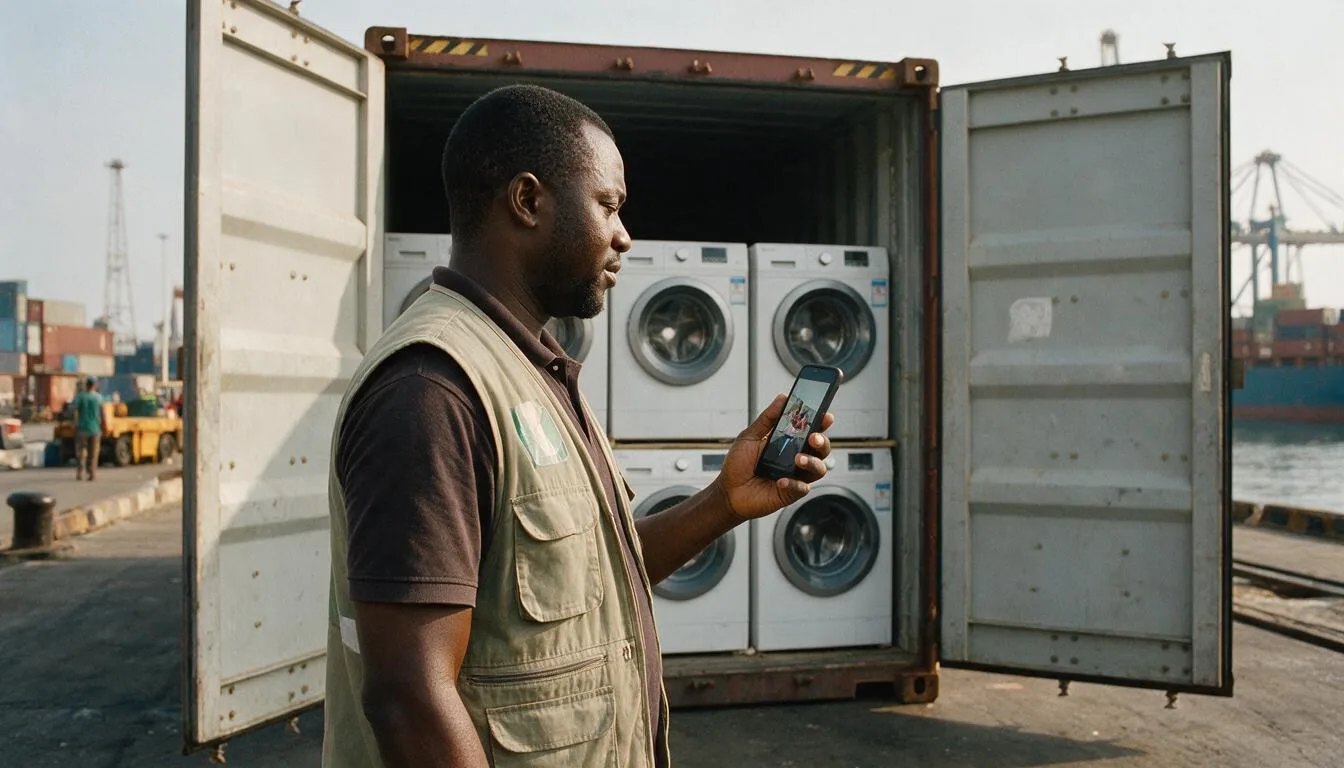
A whole container going bad almost never happens if you control the payment timing. You keep 70% of your money until you've watched a loading and run-test video of the actual units going into the actual container. If that video shows a problem, you don't send the balance, full stop.
Why this concern is real
This fear exists because it has happened to real buyers, just not with proper documentation in place. A supplier takes a full deposit, loads mismatched or non-working units, seals the container, and sends a Bill of Lading before the buyer sees anything. By the time the container lands in Lagos, Tema, or Mombasa four to six weeks later, the money is gone and the factory is unreachable. This is the single biggest fear for importers buying used appliances sight-unseen from Guangzhou, and it's a fair one — container fraud in this trade is documented, not rare.
How it actually works
A standard 40'HQ container takes 25-35 days port to port depending on destination: Mombasa runs $2,500-3,500 in freight, Lagos $3,000-4,000, Umm Qasr $2,500-4,500. Once the container is sealed and the Bill of Lading is cut, you have almost no recourse — you can't reopen it to inspect, and any dispute becomes a legal and logistics problem, not a quick fix. The only real leverage point is before the doors close. That's why serious buyers structure payment as 30% deposit to open production, then hold the remaining 70% until they've seen proof the goods loaded match the invoice — unit by unit, tested and working.
How we handle it at Apex Home Export
We built our whole payment structure around this exact risk. Here's the sequence:
- You pay 30% USD T/T deposit against a signed Proforma Invoice, with bank details confirmed on that PI and on a recorded video call — never by email alone.
- Every used unit going into your container has already been through a 27-point bench test at our Guangzhou facility, serial-number logged and graded: A (3 years or less, 90-day warranty), B (5 years or less, 30-day warranty), or C (tested working, sold as-is).
- On loading day, we send you a video of the container being packed, plus run-tests of units pulled at random from the load — you see compressors, motors, and controls actually running.
- Only after you've reviewed and accepted that video do we release the Bill of Lading copy and request the remaining 70%.
- Payment only goes to our corporate trade account, matching the contract entity name on the PI — never a personal account, never a third party.
- We never load used refrigerators, freezers, air conditioners, or TVs, and nothing counterfeit — these categories carry the highest damage-in-transit and compliance risk, so we don't touch them at all.
This doesn't make a bad container impossible. It makes it something you'd have already seen and rejected before your money left your account.
What you should do before you pay
- Confirm the contract entity name matches the bank account name on the PI — check this yourself, don't take it on trust.
- Ask for the grade (A, B, or C) and serial numbers of every used unit on your invoice before deposit, not after.
- Insist on a loading + run-test video as a written condition in your PI, not a verbal promise.
- Book a third-party inspection — SGS, Bureau Veritas, or Intertek — at your own cost if your order value justifies it.
- Never release the 70% balance until you've personally reviewed the video and matched it against your invoice line by line.
Bottom line: a disaster container is a payment-timing failure, not bad luck — hold your 70% until you've seen the proof. Message us on WhatsApp at https://wa.me/8619905922526 and we'll walk you through the video-before-balance process on your next order.